


PRELUDE TO THE MINNESOTA WILD 2026 NHL FREE AGENCY MARKET
by T.R. Holler
It’s no secret we have one of the slimmest unrestricted free agent (UFA) classes in at least a decade as last year’s top restricted status stars took less money (AAV) to stay with their teams as per Jack Eichel (Vegas) and Connor McDavid (Edmonton), among others, spoiling the 2026 FA class anticipation. Heck, even the RA (restricted free agent) marked thinned considerably in the wake of the Brady Tkachuk trade between the Sens and Panthers. Last offseason, teams with ample cap room held to conservative approaches and simply didn’t spend money simply to generate ‘faux PR’ for their respective fan base. Now, in 2026, these teams have that same cap space available for July 1 free agents as per, again, those San Jose Sharks with a staggering $39 million in cap space on July 1 while our beloved Minnesota Wild currently holding at a barely modest $6.65 million available cap post McCarron/Brink signings through June 30.
To date, both C, Dylan Larkin (Detroit) and D, Darnell Nurse (Edmonton), those of the uber-privileged ilk, have requested trades from their respective clubs, and they may not be the only big names to follow in this line of suddenly empowered me-first players, I mean, Larkin has five years remaining on his Red Wings contract. Not two, not three, but five years remaining, a fact that will never be lost on Detroit GM Steve Yzerman who we predict will remain stubbornly steadfast out of sheer ego and perhaps, spite?

Many teams, heck nearly every team, dreams to upgrade through the middle, but there’s arguably no contender more desperate for an impact first line centerman than the Minnesota Wild – a need that has proven most elusive for two and a half decades.
Yes, the post-Quinn Hughes acquisition Wild are far more entertaining and are a legit top-8 team, a Cup contender, but still not an elite top-4 squad and only one injury away from swift relegation to the all too familiar pretender pile. The Wild, with their still young and improving core are undoubtedly stuck in one of the toughest divisions in hockey, the western conferences’ central division. The Wild’s loss to Colorado in five games during Round 2 of the ’26 playoffs revealed that this is still an imperfect roster. With Joel Eriksson Ek injured, the club was rolling Ryan Hartman and Michael McCarron as their one-two punch at center for must-win games against the Avs, which simply did not get it done.
The Wild may not have the capital assets required to win the Dylan Larkin sweepstakes, but they still have assets to make upgrades. Danila Yurov is a promising 22-year-old center coming off a solid rookie year and is a worker bee with a high ceiling. Charlie Stramel, a first-round pick from 2023, is a 6-foot-3 playmaking centerman who finished a productive NCAA season with Michigan State but is rehabbing an ankle injury yet the promise of Stramel is as an ideal future middle-six pivot. Lastly, the Wild still have their first-round picks in 2027 and 2028. All those pieces could be dangled as trade chips. The question becomes what is Dylan Larkin worth? Surely not all those assets, but maybe half these assets? More importantly, what is Detroit GM, Steve Yzerman’s opinions of the Wild prospects? Our guess is that Yzerman’s perception will not match that of Wild GM, Billy Guerin nor the provincial fan base.
Minnesota may need to create more cap room to make a splash — it currently has $6.65 million in projected space, but with only 16 NHLers under contract. The good news is that there are a few options to free up more cap space, if necessary. The 15-team no trade clause on Hartman’s contract (one year remaining at $4 million) will shift to a 10-team list. Quality, but pricey bottom-six forwards Yakov Trenin ($3.5 million AAV) and Nico Sturm ($2 million) have zero trade protection, yet they provide necessary depth and playoff experience for the Wild.
 Is Dylan Larkin’s new found friendship with fellow Olympians like Brock Faber enough to help grease the wheels to get him here? (LPH PHOTO)
Larkin, friends with American teammates Matt Boldy, Brock Faber, Quinn Hughes, and having been on the last two U.S. teams under Guerin’s guidance, is a cozy fit. But whether the Wild can pull off another blockbuster is a bit more complicated for one main reason: They don’t have the upper echelon trade chips, decent assets, but not elite tier. Do the Wild deplete all their draft capital for the next two to three years? Essentially three prospects, and two first rounders being traded away for Larkin, who is a good player and fills a need for the Wild, but is the silky centerman the piece that truly propels the Wild past the Avs or Knights? Debatable, at best. The Wild would still need to fill out their middle-six wings and defensive corps which still lacks size and tenacity with the oft-injured Brodin, middling Jake Middleton, and the undersized Jared Spurgeon who has only one year remaining on his contract. That’s a lot to ponder, and still, numerous slots to fill let alone those spots being tangible upgrades.
Remember, the Wild exhausted a lot of their trade assets in the Hughes deal in mid-December, trading prospects Zeev Buium, Marco Rossi, Liam Ohgren and their 2026 first-round pick. Sure, there are solid prospects left in Stramel, Yurov, Hunter Haight, Riley Heidt, and Adam Benak, but it’s debatable whether those are the kinds of chips that can garner the likes of Larkin. Furthermore, does that prospect list impress the likes of Yzerman? Doubtful. Our guess? Yzerman will be looking for a ransom – which will be more than the Wild can offer for if they do, there will be zero depth and zero prospects left.
The Wild’s top “prospect” or bargaining chip is goalie Jesper Wallstedt, who was dangled at last season’s deadline for St. Louis Blues center Robert Thomas and, supposedly NY Rangers centerman, Vincent Trocheck. But it’s hard to see the Wild moving Wallstedt, who looked like their No. 1 during the playoffs, with Filip Gustavsson rehabbing from hip surgery this summer and whose availability to start the season in question – now rumored to not be available until mid-November. It’s also questionable whether Detroit would even want a goalie in a return package with its own young goalie in Trey Augustine on the heels of super vet John Gibson.
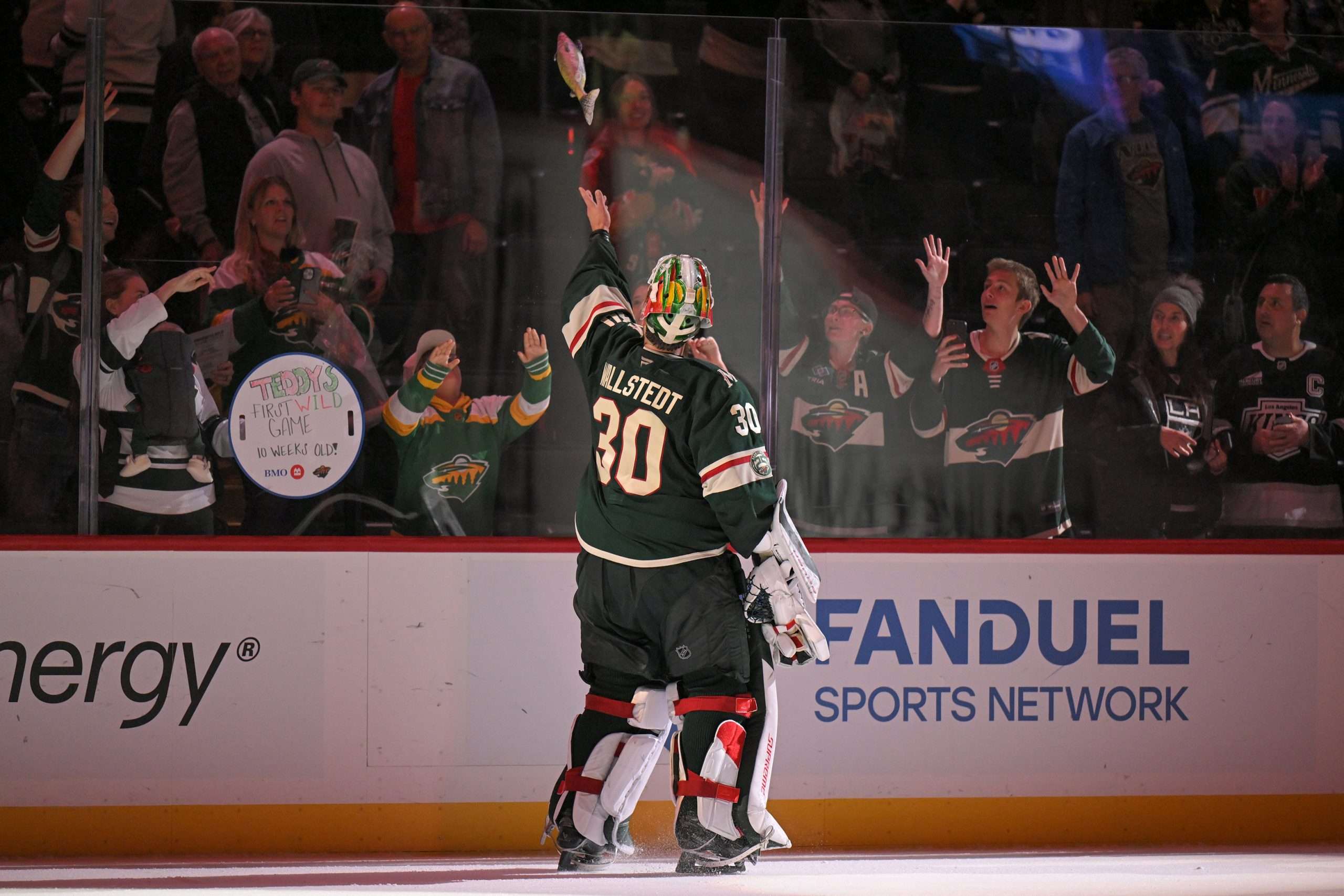 Jesper Wallstedt has become a yes man in goal for the Wild, meaning he’s a no-no when it comes to trading him. LPH PHOTO
You can look at moving some players off the current roster, and the Wild are at the point in their supposed “win-now” window that they must be open to doing that. But they also can’t take a step backward or sideways in a deal. Meaning: They’re not looking to move top two-way center Joel Eriksson Ek or shutdown defenseman Jonas Brodin. We all saw how much the Wild missed those two players in their second-round loss to the Colorado Avalanche. You trade Eriksson Ek in a Larkin deal, and suddenly you’re one top-six center short again – simply put, the juice ain’t worth the lateral squeeze. Personally, whatever the Wild give for Larkin? We would loathe to see Wallstedt and more top draft picks evaporate into the abyss.
As of now, Larkin is the big fish on the market, and part of that is he’s the only one of those players known to be available at critical need position for the Wild. Vincent Trocheck could be a Plan B for the Wild, who pursued the veteran heavily at the deadline but passed at the New York Rangers’ asking price. But, if we argue Larkin isn’t enough to tip the scales, then maybe neither is Trochek. Nice, high-grit player who is solid on faceoffs but again, not enough for scale tipping and he is aging…quickly.

The Wild did not have a first-rounder this year (only three non-descript selections overall) and while they maintain their firsts in 2027 and 2028, how much value do they carry? Especially if they’re likely to be late first-rounders? In addition, there are zero second-round picks for the next three years due to the disastrous David Jiricek boondoggle. Perhaps keeping those two successive first round selections in ’27 and ’28 is the prudent move.
Perhaps the Wild can get creative and bring in a third team, acquiring an asset Detroit would find more tempting. It makes all too much sense for the Wild to do whatever it can to make it happen. So, we shall see just how busy Billy G will be heading into the 4th of July weekend.
In the end, any shot at Larkin must make sense for Yzerman, too. He will not serve Larkin, he will serve what is best for Detroit long-term and the pressure was already on Yzerman to get Detroit back into the playoffs ASAP. Right now, it truly feels like a long shot for the Wild and, that’s ok. Local and national media keep tossing out the Wild’s “win now” phrasing, but that’s all it is – clickbait phrasing. Yes, as fans and puck purveyors, we are desperate to move the needle after twenty-five years, but let it be re-iterated: the core of the Wild are young and still improving with Kirill Kaprizov, Matt Boldy, Eriksson Ek, Brock Faber, Quinn Hughes, and Jesper Wallstedt. Win now? Sure! But it’s not a one or two-year window here, the core, especially after the pending Hughes extension, that rumored window is, at minimum, a guaranteed four years.
It’s going to be ok, folks. Sometimes, the best moves are the ones you don’t make. So, Billy G – let the world turn, let the allure of Larkin evaporate and sign Hughes, replenish the roster with the youth movement and prep for the February trade deadline and next year’s July 1 free agent market. You will have made a 1st rd. selection in the ’27 draft and will have a reported near $35 million in cap space to jump into next year’s flat circle and wheel and deal on July 1, 2027.